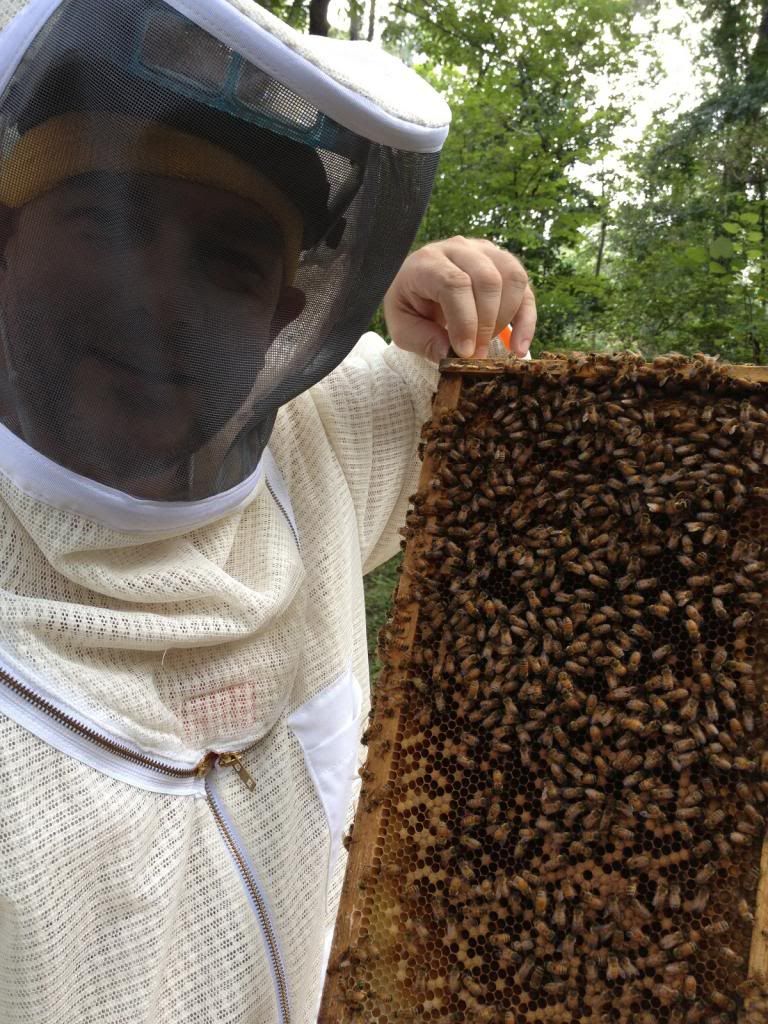
A cut out is when you have a group of bees living in the wall, floor or some other void space in a building and need to remove them. In order to remove the bees you need to cut open the structure and pull out the bees...but of course it sounds MUCH easier than it is to do.
I've watched just about every JP the Beeman video on youtube
He does some awesome cut outs, typically without any protection and it looked like great fun.
The best way to do them is to FIRST LEARN FROM EXPERIENCED BEEKEEPERS. In my case I told the leaders at the Alachua County Beekeepers club that I'd be more than happy to help...and on Friday they called me up to join them.
The bees were in a corner board of a beautiful victorian house down in Gainseville. I was told to only bring a veil however I wanted to do more than watch and showed up with my jacket, full suit, tools and bee box...which turned out to be a great idea.
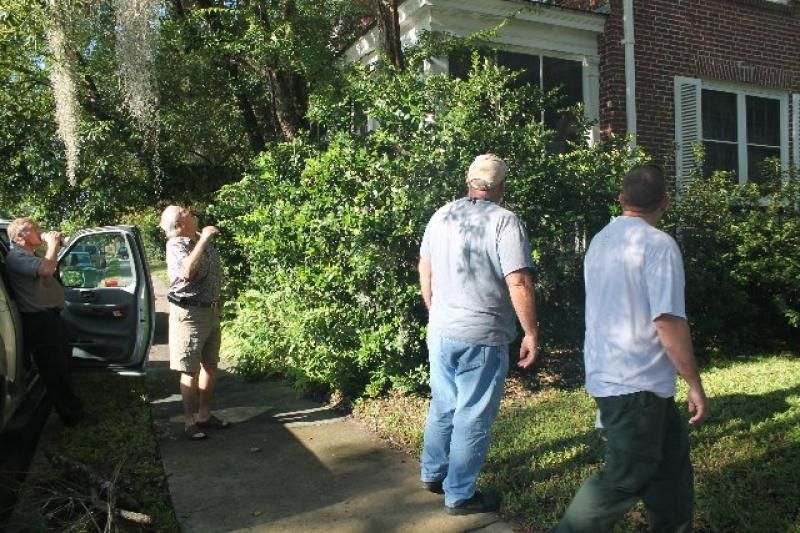
We showed up and identified the bees location, low and behind bushes. Once some branches were cut away we were able to get close to the bees and they seemed pretty calm.
I put on only my jacket and gloves and figured, heck, everything is cool like fonzie.
The bees cool vibe quickly dissipated as we took a hammer and crowbar and began peeling boards away from the building. They flew out like bruce lee and began stinging everyone...our mentor got nailed a bunch of times in succession and had to retreat to get some space and clear off the phermones.
I thought I was fine and it was just a bit humorous until I realized that some bees flew into my jacket and were now buzzing around inside with me.
bam bam bam, three stings to the back of my neck confirmed my lack of attention to detail and it was time to take a walk to the car. I had neglected to tie up the bottom of my jacket and they just flew right in.
There were still a couple bees flying around inside my hood and I was able to calmly remove myself from them at the car.
I thought, ok, gals, time to suit up for a real battle and put on my full suit, boots with velcro and thick gloves.
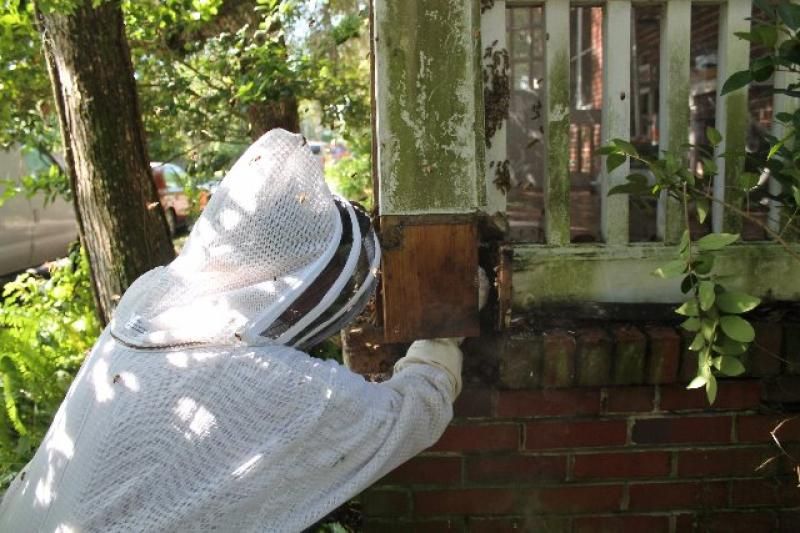
The guys had a bee vacuum and we began sucking them out.
We peeled the wood away and cut out a bunch of brood and honey. Everything went well and soon we noted the bees grouping up on the nuc box...a sure sign the queen was inside.
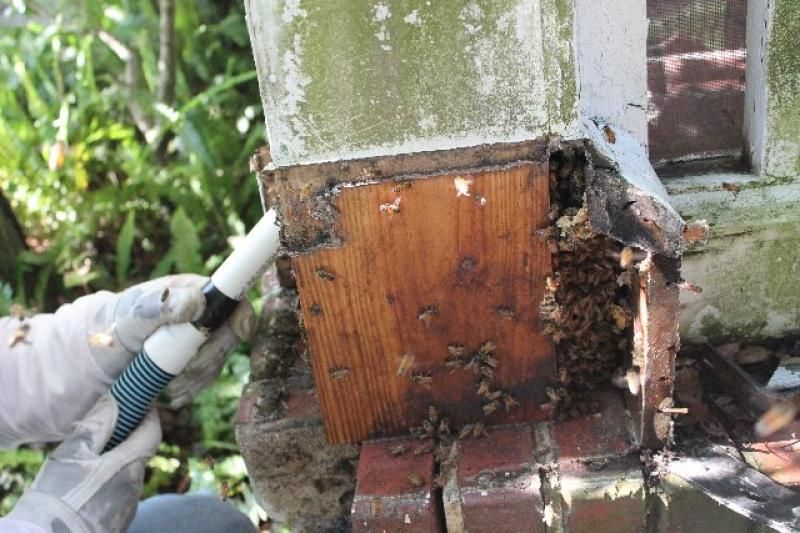
We continued cleaning up the bees however some honey got into the vacuum tube which causes their wings to be damaged, and they will die...total bummer for the last of the bees. We tried to remove all we could as the resident wasn't as fond of bees as we were.
Once the bees were loaded up we secured the hives and took off for the day.
It was a heck of a good time, always nice to save bees that someone may just decide to kill.
There are a bunch of important components to doing cut outs...the MOST IMPORTANT is to have insurance and LEARN WHAT YOU ARE DOING.
After this job a report came in that a team tried to do a cut out in Ocala and botched the job, requiring someone experienced to come in and make it right. That type of thing just gives responsible beekeepers a bad name.
There are a bunch of experienced folk at local beekeeping meetings. Come on by and learn how cool beekeeping can be!
Wednesday, August 7, 2013
Saturday, July 27, 2013
Finding Queens and getting Stung!
Checking out frames with the optivisor and I could see details of eggs, capped and uncapped brood...and there she was, the queen!
I was super happy to have found her, however I didn't have my queen clip on me and wasn't able to mark her.
I managed to get a video showing the queen. She is on the right middle part of the video, near the right edge of the frame, and has a much larger body than the bees around her. She is a critical part of hive function and is constantly laying eggs.
I reassembled the hive and did a quick sugar treatment.
Since that went so well i figured, heck, why not inspect hive 3, my ten frame with two supers/levels...what could go wrong?
I placed the super on the stand between hive 1 and 2...without a top or bottom...so you know, the bees start getting robbed but it's fine, because I'm busy with the bottom super having a great ol time looking for signs of the queen and don't notice anything wrong.
The bees were super friendly. I removed 6 frames and found plenty of evidence a queen was laying. I assembled the bottom super and was feeling super confident, using little to no smoke, everything was going great.
...until i looked right and noticed the super. It was clear that bees were very unhappy about the situation. I thought, I'll just go over there and quickly move them back....there was a quick nagging feeling that may not be so smart...naa it'll be fine.
bam bam bam three stings to my right hand.
While walking away I thought of ways to cover the supers while doing inspections.
Went and got some gloves and a suit, came back, smoked them good and reassembled the hive.
I'm thinking that next time I'll have a screened bottom board and top cover ready to stack the supers.
Wednesday, July 24, 2013
Bringing Home the Nucs!
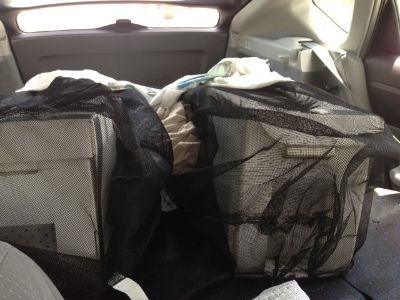
The safest way to transport bees would NOT be in the rear of a hatchback.
While this is obvious to anyone moving bees some of us don't have trucks.
Let me be real clear, it takes around 1,400 bee stings to kill a person, each of those nuc boxes contain over 5,000 bees.
We have them covered in screens however all hell would break loose if we rolled the car.
It'd be ugly.
The safest way would be to drive with jacket on..or just use a truck.
Once we arrived home we let them sit for a half hour to relax. They weren't too pleased with the drive but we kept the ac on and protected them from the sun.
I have a ventilated jacket as well as a full suit. The full suit is pretty cool for dealing with unknown bees. When I installed my first nucs I was fully protected with gloves and all.
This is an unnecessary level of protection as I soon found out.
I really like my hive frame holder which keeps removed frames clean and safe while I'm working.
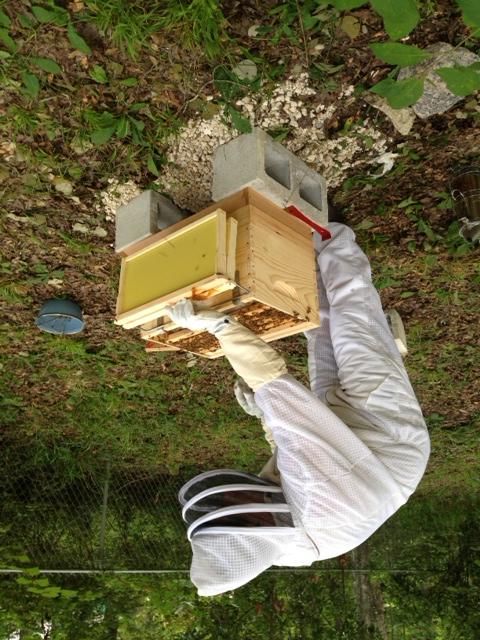
I installed the hives onto concrete blocks, inserted the five frames into the middle of my 8 frame deep hive bodies and moved onto the next nuc.
It is really fascinating watching the bees. I spent some time looking at the frames and was able to identify drone and worker brood cells. I have a ton to learn as I didn't find the queen...I'll keep looking!
While this is obvious to anyone moving bees some of us don't have trucks.
Let me be real clear, it takes around 1,400 bee stings to kill a person, each of those nuc boxes contain over 5,000 bees.
We have them covered in screens however all hell would break loose if we rolled the car.
It'd be ugly.
The safest way would be to drive with jacket on..or just use a truck.
Once we arrived home we let them sit for a half hour to relax. They weren't too pleased with the drive but we kept the ac on and protected them from the sun.
I have a ventilated jacket as well as a full suit. The full suit is pretty cool for dealing with unknown bees. When I installed my first nucs I was fully protected with gloves and all.
This is an unnecessary level of protection as I soon found out.
I really like my hive frame holder which keeps removed frames clean and safe while I'm working.
I installed the hives onto concrete blocks, inserted the five frames into the middle of my 8 frame deep hive bodies and moved onto the next nuc.
It is really fascinating watching the bees. I spent some time looking at the frames and was able to identify drone and worker brood cells. I have a ton to learn as I didn't find the queen...I'll keep looking!
Subscribe to:
Posts (Atom)